High Quality Payroll and HR Services
Client Resources News & Tips Email Us 610-310-7615

Feb 15, 2024
Keep Calm and Carry On Under Fire
Every organization can be vulnerable to some kind of crisis. The variety is possibly infinite, depending on the size and scope of the business. Even a broken pipe and a flood could prove disastrous for a small business. Read through for a brief lesson on crisis management.
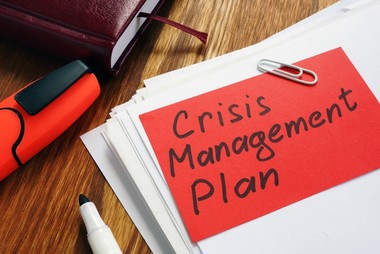
Usually, serious crises pose threats and embody an element of some surprise stemming from unique or unanticipated events. Although the probability of occurrence may be rare, the resulting impact can be immense.
The art of crisis management involves managing, preparing for, limiting and mitigating damage. It calls for prompt and resolute actions driven by swift decisions that are often made on the fly. Customers or key employees could flee in droves, operations could be disrupted and assets such as factories and offices could be affected. Managing and not managing a crisis correctly could impact an organization, people's livelihoods and even the physical safety of employees. At all costs, you want to prevent a catastrophe, which is the result of a badly handled crisis.
So much can go wrong
While each unique crisis ultimately requires its own solution, major corporate threats tend to fall into certain categories, such as:
- Natural disasters — storms and hurricanes such as Katrina, the 2021 U.S. tornadoes, and the 2016 earthquakes in Kumamoto, Japan, which also impacted companies that relied on manufacturing that occurred there.
- Technology — breakdowns, such as Google's in 2020, software malfunctions, and data breaches and losses.
- Deception and unethical and illegal conduct — Wells Fargo created fake unauthorized accounts, leading to a $3 billion settlement for the impacted victims of this fraud.
- Accidents — A 737 MAX aircraft suffered two fatal crashes in 2019, causing grounded airplanes, canceled flights, travel disruptions and a blow to Boeing's stock price, finances and reputation.
- Financial — cash flow or credit crunches, from individual firms to widespread contagion, such as the Great Recession.
Globalization amplifies the consequences of local flare-ups with a domino effect. At the same time, modern technology, such as social media, increases the rapid spread of rumors and negative information. Consequently, the window for damage control has narrowed.
Proper prior planning prevents poor performance
Those six words sum up the best defense against the unknown and unknowable. The general goal of crisis management is to return the business to normal as soon as possible and with the fewest possible repercussions. Having a plan is central to achieving that. However, since every crisis is unique, it is futile to try to construct systematic step-by-step plans to fit every contingency. The only practical solution is to learn and evolve midstream, if necessary, and be ready to adapt tactics to fit the current problem.
Ian Mitroff, an organizational theorist, has developed a highly regarded five-stage model for managing crises:
- Signal detection — prepare and prevent by monitoring early signs closely.
- Prevention/preparedness — actively probe for risk factors.
- Damage containment — keep a crisis from spreading and contaminating.
- Recovery — return to normal systems and operations as soon as is feasible.
- Learning — perform a thorough review, critique for lessons learned and redesign to prevent future recurrences.
Large organizations sometimes employ a dedicated crisis manager. In smaller settings, the HR department may serve as a channel for consistent internal communication and feedback. A crisis team typically comprises the head of each department, the company lawyer and an HR representative. And a team member can coordinate sub-teams.
Some golden rules
Panic is never the answer. A crisis sometimes brings out the best in leadership. That is when character is ultimately tested in the workplace. You should assume your colleagues are also feeling the heat. They will draw on your example if you can keep a cool head.
Above all, be honest and keep the lines of communication flowing to all stakeholders. Do not make excuses. Holding yourself accountable is a sign of a true leader. It may be tempting to downplay the gravity, but do not pretend you hold a nonexistent solution or make unrealistic promises you cannot fulfil. If there is a risk of redundancies to come, it may be fair to warn employees.
Try to stay organized. Keep providing updates, even if nothing has really changed. You could trigger mass anxiety if you suddenly clam up, as co-workers will suspect the worst. Regular meetings can help boost morale.
©2024

MORE RECENT NEWS…
Aug 27, 2026
Where Remote Work Stands Today
The pandemic reshaped how and where work gets done, disrupting the U.S. office market and accelerating the shift toward remote and hybrid models. While return-to-office efforts have focused on productivity, collaboration and culture, they have also been influenced by practical concerns such as long-term leases and underused office space. Read through to see how hybrid work continues to evolve.
Aug 26, 2026
Protecting Your Company From Online Defamation
Your company has terminated an employee — and now you're bracing for what they might say about their former workplace online. Social media can turn a disgruntled former worker into a very public critic. Read through for an overview of ways to prevent disparagement through culture and policy, deter it with a nondisparagement clause and respond to it with legal help.
Aug 25, 2026
Newsflash: Enhancements to the Paid Family and Medical Leave Tax Credit
Employers, including small businesses, that provide paid family and medical leave to their employees may be eligible for an employer tax credit. Read through to read about several new enhancements to this credit under the Working Families Tax Cuts.
Aug 24, 2026
Protect Your Business From Cybersecurity Attacks
No matter what the size of the organization, all businesses face the threat of cybersecurity attacks. Small businesses in particular feel vulnerable to cyberattacks. Read through for a discussion about what small businesses are doing to secure their data.
More News & Press can be found in our Archive.
Panacea Payroll
3277 West Ridge Pike
Suite A101
Pottstown, Pennsylvania 19464
610-310-7615

MEMBER OF








WE'RE SERIOUS ABOUT SECURITY
Staying resilient from malicious threats, cyber and physical, is critical in providing the exemplary value our clients expect from us. To do this, we integrate the National Institute of Standards and Technology's (NIST) Cybersecurity Framework that ensures our security procedures, policies, and infrastructure are up to the highest standard possible. Financial institutions, infrastructure management, defense, healthcare, and other heavily regulated industries that rely on stringent information safeguards use the NIST Cybersecurity Framework. We review our security policies and procedures frequently to ensure newly identified threat and vulnerability information is incorporated. Our network infrastructure and physical locations are continuously monitored for anomalies and uninvited guests. Additionally, our incident response and business continuity plans are tested frequently to minimize the likelihood of backup failures.
© 2026 Panacea Payroll, All Rights Reserved.