High Quality Payroll and HR Services
Client Resources News & Tips Email Us 610-310-7615

Mar 14, 2024
Honesty and the Resume
In today's competitive employment market, some job seekers feel compelled to exaggerate their past job experience to impress their potential bosses. In the scramble to land top jobs, many candidates are, shall we say, less than honest when writing their resumes. Read through for some thoughts on handling resume lies
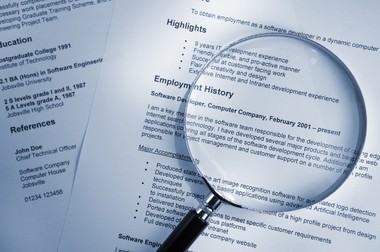
Lying on applicants' resumes covers a wide spectrum, ranging
from stretching the truth just a little to telling blatant whoppers. In
between, human resources managers deal with a broad gray area, ranging from
fibbing to fudging to padding. How seriously do HR managers treat inaccurate
details on resumes and cover letters? Should they dismiss those jobhunters
outright or overlook a modest exaggeration?
Risks and consequences
For candidates eager to land a good job, lying is often a
calculated risk. Potential candidates are all too aware that their chances of
beating the odds are high. According to a 2020 ResumeLab survey of 1,051
Americans, only 30% of job liars got caught. The actual percentage is likely
even lower, as HR departments typically take no action when they discover
falsehoods or reject a suspicious resume — it goes into the trash and the
episode ends there.
The same study shows that even among those who make it
through the hiring process, only 30% are fired for their lies, whereas 22%
escape lightly, with only a reprimand. Companies usually ignore the matter
until a tangible problem arises. At worst, a candidate can withdraw or update
their resume.
Since lying on resumes is relatively easy to get away with,
what would make liars hesitate other than a basic sense of morality? Those
already hired obviously risk losing their job. The ripples can spread wider,
though, tainting the liar's reputation (news travels fast these days) or even
occasionally leading to legal action. They may also find it harder to gain
other employment if a termination for cause in their work history sets off
alarms. Lying is seen as a character defect.
A guilty conscience is not the only worry to keep them up at
night. Although most liars do escape detection, some will eventually be
exposed. Language fluency is a common resume lie. It may seem safe enough to
claim proficiency in French, but what happens when a native speaker
unexpectedly shows up at the office and starts chatting away? Or in a tightly
knit industry, a co-worker from a former job might reveal that a previous title
claimed by the employee has been grossly inflated.
In the doghouse
There are intentional lies and there are unintentional lies.
The former are flat-out falsehoods; the latter are closer to shading, such as
leaving out a material fact.
Some reported resume lies are jaw dropping. One imaginative
applicant claimed that he had worked in a jail when he had in fact served time
there himself. Sometimes, candidates create nonexistent institutions for their
backgrounds, too. For instance, one allegedly attended a nonexistent college,
while another described himself as assistant to a prime minister in a foreign
country that had no such leader. In another case, where father and son shared
an identical name differentiated only by "Sr." and "Jr."
titles, the son misappropriated his father's work experience. Still another
candidate pretended to be an Olympic medalist.
A particularly comic example came from a wannabe who termed
himself a construction supervisor. In reality, his sole construction experience
was the completion of a doghouse, and that had been accomplished many years
before.
Beyond these outlandish illustrations, most resume lies fall
into fairly standard categories:
- Skill
sets.
- Academic
degrees.
- Awards.
- Employment
dates.
- Job
responsibilities.
Dishonesty varies across industries. Per the ResumeLab
survey, retail and hospitality employees are less truthful, while education and
health care workers tend to be more exacting. Men score above women for telling
whoppers.
Guarding against liars
Recruiters and HR spend little time reviewing resumes or
checking previous employment and references. They focus on dates rather than
titles and duties. It is up to managers to perform better due diligence. Aside
from Google searches and formal background investigations, employers can always
call colleges directly or use services like the National Student Clearinghouse.
Be wary of candidates who provide dates that are
inconsistent, details they can't remember, or vague descriptions of skills and
experience, or those who exhibit uncomfortable body language. Does the
interviewee fidget and avoid eye contact? Proceed with caution and do the
research.
©2024

MORE RECENT NEWS…
Aug 27, 2026
Where Remote Work Stands Today
The pandemic reshaped how and where work gets done, disrupting the U.S. office market and accelerating the shift toward remote and hybrid models. While return-to-office efforts have focused on productivity, collaboration and culture, they have also been influenced by practical concerns such as long-term leases and underused office space. Read through to see how hybrid work continues to evolve.
Aug 26, 2026
Protecting Your Company From Online Defamation
Your company has terminated an employee — and now you're bracing for what they might say about their former workplace online. Social media can turn a disgruntled former worker into a very public critic. Read through for an overview of ways to prevent disparagement through culture and policy, deter it with a nondisparagement clause and respond to it with legal help.
Aug 25, 2026
Newsflash: Enhancements to the Paid Family and Medical Leave Tax Credit
Employers, including small businesses, that provide paid family and medical leave to their employees may be eligible for an employer tax credit. Read through to read about several new enhancements to this credit under the Working Families Tax Cuts.
Aug 24, 2026
Protect Your Business From Cybersecurity Attacks
No matter what the size of the organization, all businesses face the threat of cybersecurity attacks. Small businesses in particular feel vulnerable to cyberattacks. Read through for a discussion about what small businesses are doing to secure their data.
More News & Press can be found in our Archive.
Panacea Payroll
3277 West Ridge Pike
Suite A101
Pottstown, Pennsylvania 19464
610-310-7615

MEMBER OF









WE'RE SERIOUS ABOUT SECURITY
Staying resilient from malicious threats, cyber and physical, is critical in providing the exemplary value our clients expect from us. To do this, we integrate the National Institute of Standards and Technology's (NIST) Cybersecurity Framework that ensures our security procedures, policies, and infrastructure are up to the highest standard possible. Financial institutions, infrastructure management, defense, healthcare, and other heavily regulated industries that rely on stringent information safeguards use the NIST Cybersecurity Framework. We review our security policies and procedures frequently to ensure newly identified threat and vulnerability information is incorporated. Our network infrastructure and physical locations are continuously monitored for anomalies and uninvited guests. Additionally, our incident response and business continuity plans are tested frequently to minimize the likelihood of backup failures.
© 2026 Panacea Payroll, All Rights Reserved.