High Quality Payroll and HR Services
Client Resources News & Tips Email Us 610-310-7615

Aug 17, 2020
At-Will Employment: What Does it Mean?
You've heard the term - let's dig a little deeper!
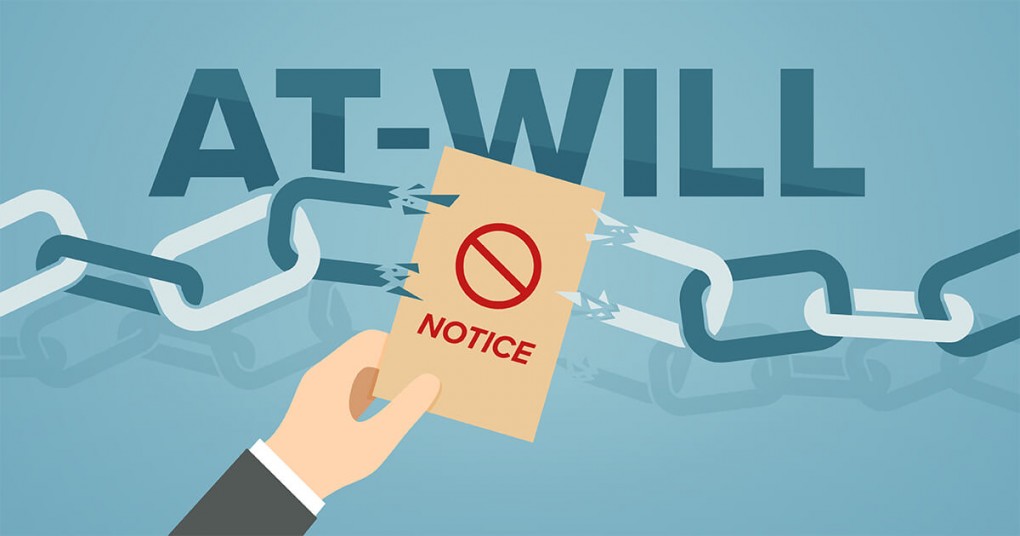
In every state in the U.S.A, excluding Montana, employer-employee relationships are considered to be "at-will," meaning that said relationship can cease to exist at any time, or for nearly any reason. There are, of course, exceptions to this rule, but the overarching theme is that employers and employees may both choose to end their association without cause. With this in mind, the language of at-will laws begs the question:
Does “at-will employment” mean we can terminate without risk?
No, termination always comes with some risk, even when the employment is at-will. While at-will employment allows either you or the employee to terminate the employment relationship at any time, with or without notice, and with or without cause, it doesn’t allow you to terminate employment for an unlawful reason which includes termination based on the fact that the employee exercised a legal right (like taking family leave or sick leave) or belongs to a protected class (e.g., age, disability, race, sex, religion, national origin).
There’s even some risk when the termination is for cause, because a terminated employee could claim that your reasoning is just for show, and that they were actually terminated for an illegal reason. That risk grows exponentially when you don’t provide the employee with a legitimate reason for the termination. This is why we suggest you tell a departing employee the factual reason(s) why they are being let go rather than falling back on “at-will employment” to avoid explaining your reasoning.

Consequently, the safest way to terminate an employee is to have documentation that justifies the legitimate business reasons behind the termination. If the termination is due to the employee’s behavior or performance, documentation would include infractions of policy, instances of poor performance, and any disciplinary or corrective action taken. If the termination is due to a layoff or reduction in force, documentation would show that there was no work available and identify the business reasons for eliminating the position. If you aren’t laying off everyone in a particular job group, however, you’ll still want objective documentation that shows why this particular person was selected for layoff, such as less impressive performance or less seniority than their peers. More in-depth information regarding at-will employment laws and consequences can be found here.
The more you can do to show that you had a legitimate business reason for a termination, the harder it will be for an employee to fill in the blank with their own illegal reason for termination, and the less risky it will be. For additional information, visit HR Support Center to stay up-to-date!

MORE RECENT NEWS…
Sep 24, 2026
Job Openings? Look Toward Community Colleges
Employers are painfully aware that they face a 21st-century skills shortage. Companies are bent on hiring a "new collar" workforce to keep up with advances in technologies like artificial intelligence and automation. Read through to learn about an untapped resource.
Sep 23, 2026
With the IRS, As with Courts, You're Entitled to Representation
If you're having a problem with the IRS, you have rights! For one, you don’t have to go it alone. You are allowed to have an expert in your corner. Read through for details on the regulations that protect you.
Sep 22, 2026
Just What Are 'Competitive Wages'?
Inflation is a key challenge that businesses of every size face when developing compensation strategies. Read through to see how your business can position itself in the competitive wage war to attract and retain employees.
Sep 21, 2026
What the Gig Economy Is Doing to Traditional Payroll Structures
The gig economy, characterized by companies hiring short-term, contract or freelance workers, has been surging since the 2020 pandemic when people were mandated to work remotely. By current estimates, one-third of American workers are doing some form of gig work. Read through to learn more about what this arrangement is doing to traditional payroll structures.
More News & Press can be found in our Archive.
Panacea Payroll
3277 West Ridge Pike
Suite A101
Pottstown, Pennsylvania 19464
610-310-7615

MEMBER OF









WE'RE SERIOUS ABOUT SECURITY
Staying resilient from malicious threats, cyber and physical, is critical in providing the exemplary value our clients expect from us. To do this, we integrate the National Institute of Standards and Technology's (NIST) Cybersecurity Framework that ensures our security procedures, policies, and infrastructure are up to the highest standard possible. Financial institutions, infrastructure management, defense, healthcare, and other heavily regulated industries that rely on stringent information safeguards use the NIST Cybersecurity Framework. We review our security policies and procedures frequently to ensure newly identified threat and vulnerability information is incorporated. Our network infrastructure and physical locations are continuously monitored for anomalies and uninvited guests. Additionally, our incident response and business continuity plans are tested frequently to minimize the likelihood of backup failures.
© 2026 Panacea Payroll, All Rights Reserved.